Saturday, 1 July 2017

Wieliczka Salt Mine

Even the chandelier crystals are salt
After being let down at Auschwitz, we were blown away at Wieliczka. This is Polish Disney world, or a working medieval salt mine on the outskirts of Krakow. This place knew how to get a lot of people through small enclosed spaces, whilst never feeling claustrophobic or rushed by other tourists. The salt mine was opened in the 13th century and was working continuously until 2007. It was awesome!

You go down in this tiny little 3-level elevator, where as many people are crammed in as possible, and then a few more people are added. And I'm thinking, oh man, what have I got myself in for, is this going to be super uncomfortable and claustrophobic the whole time. But after the trip down, you get out into this large cavern and tunnels. No need to duck your head. You are surrounded by salt, but it's not just boring tunnels, the miners got really artistic and started carving statues and even a whole cathedral down there.

It's really quite amazing, and not at all what I was expecting. I was thinking some really small cave-like mine. All rough-hewn with rocks all over the place, and maybe a few glimpses of salt. But these are perfectly smooth tunnels, carved directly in the salt. And it's huge, 300m deep and 287 km long, when you visit you are walking along tunnels that were made in the 16th and 17th centuries. Which is crazy to think about. You definitely want to visit this place when you come to Krakow, it is for sure worth it.

The Last Supper - in salt
The amazing cathedral

They have gone full tourist with this experience too, there are shops and cafes and meeting rooms down there. You can even spend the night or get married down there. I did not expect there to be something like this in Krakow. I really should have done more research before visiting. I have really been remiss in my central European studies.

Saturday, 24 June 2017

Auschwitz

The barracks at Auschwitz
One of the main reasons I wanted to visit Krakow was to go to Auschwitz. I had been to Dachau before and that was overwhelming. Dachau was never a mass extermination camp the way Auschwitz was. I wanted to get a sense of how bad it really was.

Dachau seemed to be set up as a memorial to the people who died as well as making sure no-one forgot what had happened. I never got that same feeling in Auschwitz.

Barbed wire fences at Auschwitz
When you visit Auschwitz you have to go with a guide, they had 2 million people visit in 2016 and it seems they feel this is the only way to manage that many people coming through. It ended up feeling very different from Dachau. There I remembered a very solemn atmosphere with time to look around and feel what had happened. In Auschwitz you are forced into a group of 50 people, given earphones to hear the guide, and then follow on the heels of another 50 person tour group. With yet another massive group right behind you.

There was never any time to contemplate things, you were forced on the move the whole time. And even though Auschwitz is quite large, all the tour groups go to the same buildings. So you are constantly squeezing past people or waiting for other people to clear the rooms ahead of you. It feels like they have made the decision that everyone who wants to see Auschwitz should be allowed the opportunity, which is an admirable decision. I worry that in making sure everyone can visit that they are destroying what they should be preserving.

Chimneys at Birkenau
The end of the tracks at Birkenau

I would not go with an organised tour if you can help it. We went because it seemed the easiest and I thought a guide would help understand what is around you. Auschwitz is 60km outside Krakow and is not super simple to get there independently. If you arrive before 10am you don't have to join a tour, I would definitely do that if you can. That way you can take as long as you want, I think there are audio guides and there are also information boards all around the place. It wasn't as if the guide added anything in terms of information or emotion, so don't feel like you are missing anything. That way you can avoid the crowds of people and actually remember what should be preserved.

Inside the barracks at Birkenau
Even though the atmosphere wasn't what I was expecting you still leave blown away at what happened. Another of those overwhelming moments.

Auschwitz ended up being too small for the Nazis and they progressively built more and more camps around the town. That was another thing I didn't realise, Auschwitz used to be an army barracks and it's in a town, Oswiecim. I always imagined these places being in the middle of nowhere.

We visited Birkenau at the same time, it's about a kilometre from Auschwitz, and it's an almost empty field, it's massive, but most of the sheds where people used to be kept have been destroyed. Because the original barracks at Auschwitz were too small for the Nazi's extermination plans, they built Birkenau. Birkenau was really something else, just this train line ending in the middle of this field. When the prisoners arrived, after being locked in train carriages with no food or water whilst they travelled from wherever they lived, they would then be sorted, the old, infirm and children immediately murdered. The inside of the barracks here were horrible, the bare minimum to be considered a shelter. I can't imagine this place during winter, it must have been freezing.
The Nazis destroyed the gas chambers before they abandoned Birkenau
I think it definitely needs visiting, but don't use it as a learning experience, do your learning before you come. And go early in the day, by yourself, if you can.

Saturday, 17 June 2017

Tring Circular - Day Walk

Cool forest at the start of the walk
I think this is one of the better walks around London. It's a circular walk from Tring, north west of London. We did this walk back over Christmas, there was still some frost on the ground in the morning. But otherwise it was a glorious day, beautiful blue skies the whole day, though still pretty chilly.

From the train station you follow the ridgeway to Ivinghoe Beacon, the ridgeway is one of Britain's oldest roads. It links Avebury (near Stonehenge) with Ivinghoe Beacon and people have been using it for 5000 years. I was thinking Ivinghoe Beacon might be some ancient Roman ruin on a hill, but it's not, you do have to kind of climb up to it at least, at a mighty 233m high. It did have a good view, and there was some memorial on it.

Once you are at Ivinghoe Beacon you then start the Icknield Way, a great name for a walking trail. This is a modern route that tries to follow, as closely as possible, another ancient road. Along this whole first section you are walking along this chalk ridge, which is kind of cool. You are getting great views for this whole morning.
View from the Beacon
The Bridgewater Monument

Along this section there is also meant to be one of the best bluebells woods in the country, that's a big claim in Britain. But since it was December we thought we may as well give it a miss. A reason to come back in spring!

For most of the day we were in lovely sunshine, but there was one weird point, where we entered this dense pine forest, the trees were so close together that it was really dark in there. Quite spooky!

After the spooky forest it was on to Bridgewater monument, this is in the Ashridge Estate. The most famous owner of this estate was the "Canal Duke", Francis the 3rd Duke of Bridgewater. He was apparently the builder of the first "true" canal in Britain. He built it to transport his coal from his mines to Manchester. Apparently this canal was such a success it kicked off a mania for canal building. In remembrance of this first canal this monument was built in 1832, it was a pretty massive monument for just the first canal.

How haunted does this forest look?

Saturday, 10 June 2017

Krakow

The market square with huge church on right
We have just got back from an 18 day adventure through central Europe. I would have said Eastern Europe, but when we were there all the locals were very clear we were in central, not eastern, Europe. I don't know if it's an Australian thing, but I never really knew there was a centre in Europe, it was either east or west. I think they don't like to say they are eastern, because that was the countries behind the iron curtain. And I guess those countries now bare little resemblance to what they were like back then. Perhaps it's also because those countries want to be closer to western Europe, and central is closer than eastern.

Anyway it's things like this that made the whole 18 days a massive learning experience. Everyday it was another new thing. I thought I had kind of a handle on history, but then I visited central Europe. There have been a loooot of wars through this region, it feels like almost constantly, so that has really added to the history.

Awesome old street - with great facades
We were in Krakow over Easter, which turned out to be super cold. And also everyone seemed surprisingly religious. I don't think many places would be shut in London just because it was Easter. We are a much less religious society I think. On good Friday, which I would have thought was the more holy day, everything seemed to still be open. But then Saturday, Sunday and Monday most things were closed. On Saturday everyone was walking around with little baskets full of food. It seemed they went to church to get their food blessed and then they ate the food on Sunday. I'd never heard of that Easter tradition. There didn't seem to be as many chocolate easter eggs around either. I don't think you could avoid them in London, but I hardly saw any in Krakow.

I'm not sure if people are actually more religious in Krakow, or if it was because it was Easter, but all the churches were full. No matter what time we visited. Not only that, if Polish people entered they would always kneel down and cross themselves. I never knew what genuflecting was before I saw it in action. I've never seen that in any English church, granted they are always completely empty when I visit, so maybe some people here still genuflect. And it's not as if it was only old people in the churches, it was young people too. English priests would kill to get those demographics.

Another church in Krakow
There were also a lot of churches, it's as if every tourist site was a church. I've never seen so many. It was like if you replaced all the pubs in London with churches that would be Krakow. And there were very few pubs in Krakow. It's almost as if the English worship a different type of God. There would be churches right next door to each other, and they all seemed to be the same faith. It wasn't as if there was a Catholic church next to an Orthodox church, they are pretty much all Catholic. It's hard to describe just how many churches they have.

As a tourist Krakow is a pretty cool city to visit. It has a really big old town, with wonderful facades and cobblestoned streets (and a lot of churches), there is also a castle on a hill. They have done a great job with maintaining the town, and I guess joining the EU has really helped them. Outside the old town is a bit different again, more gritty, but they still have an old Jewish quarter as well as the Jewish ghetto. Polish Jews didn't do so well during the war. It feels a bit like Berlin, if Berlin ever gets too expensive for the artists I feel like Krakow would be a good fit. I'm not too sure about the current government though, maybe they would have to be a bit less right-wing.

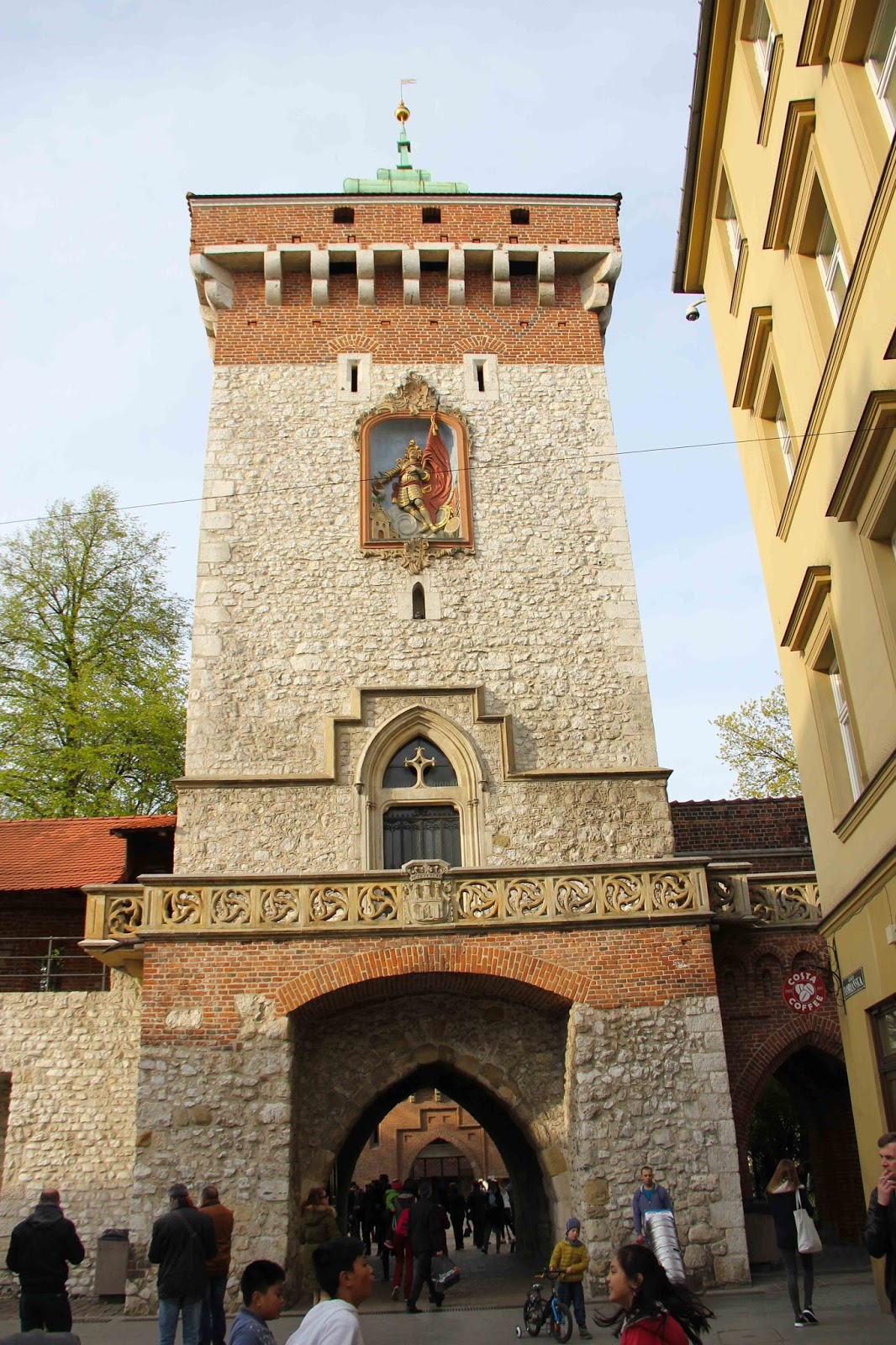
Last gate remaining from old walls
Circling the old town is a strip of park, called the Planty, great name! And it does a good job of separating the old town from traffic, you do feel isolated from the modern world once you are passed the Planty.

The market square is really something to see, it is massive, with 3 churches, of course. It dates back to the 1200's and there is this super old church kind of in the middle. This church is 1000 years old, and you actually have to go down steps to get inside, since the ground around it has risen from when it was built. It's a tiny little church inside, though from the outside it looks much bigger. The churches here all seem to have massively thick walls.

The main church is St Mary's, every hour a trumpeter plays from all four corners of the main tower. Each time they play the tune is cut off mid note. This is to commemorate a 13th century trumpeter who was shot in the throat whilst warning of the Mongol invasion. I never knew Mongols made it this far East, crazy!


Monument to the battle against Teutonic knights
There also used to be a commonwealth of Poland and Lithuania, again I never knew this. And the combined army took on and defeated the Teutonic knights in one of the largest battles in medieval Europe. Again I knew nothing about this.  The history you get living in London is so skewed to western Europe (meaning England and France) that you wouldn't think there were any other nations of note, and certainly nothing important happening anywhere else in Europe. This trip really opened my eyes to how western Europe centred my focus has been. The Teutonic knights had the largest castle in the world, which still exists in Malbork in Poland. This sort of stuff was why the trip was kind of overwhelming. Every day you are learning this mind-blowing stuff, you can never "do" Europe, the depth of history and stuff here is just crazy.


Wednesday, 17 May 2017

Oxted Circular - Country Run

We have been getting into the country walks around London lately. They are generally on pretty 
Dave outside St Peters church
good paths, so we thought we would try one as a run. This was in the middle of winter so we needed to make sure it was a good day, and luckily we found a cracker. Oxted is almost due south of us, and I always find it impressive that the Saturday Walkers club manages to squeeze such good walks in between the fairly high density of villages in England. I have recently bought a month subscription to the Ordnance Survey, this is the company that owns all the map data of Britain. I am keen to see how these maps work on my mobile. Supposedly they work without data, and it's really easy to plan a route on the computer, that you can then follow on your phone. I'll have to see how the phone battery lasts when I give it a go. For this run/walk it was down to the walk directions only though. These are always a bit weird, especially if you don't bother with the map. Since it's stuff like follow the path 150m, after the third wooden bench, veer right. You really have to put your faith in whoever wrote the directions. They haven't led me wrong yet, but I feel a lot more comfortable having the OS maps on my phone.
I'm not sure why this was in the middle of the wood
On the way out of Oxted there was this great old church, I think the tower was built in 1180, there was someone practising the organ when we visited. I guess that's a hard instrument to learn, since you can't really practise at home. Once we were out of Oxted it was then through woodlands for the rest of the day. It was winter so there weren't a lot of leaves on the trees, a lot on the ground though, which made for pleasant running. There was also an old Roman road we crossed over, that was pretty cool, it was in the middle of a wood, and I think people had tried to keep using it through the ages as there seemed to be cobblestones or rocks laid out in some parts.
Great running surface
We were pretty good with the directions in general, only making a wrong turn once or twice. It was a pretty good choice for a run, minimal mud, and fairly flat. We could cover the 19kms in just a few hours, then time for a massive Subway and back home to warm up and recover. I think we can definitely fit a few more of these into the routine.

Saturday, 13 May 2017

Guernsey

A lovely day on Guernsey
We had a long weekend in Guernsey, this is the British channel island, next to Jersey. We were there in late winter, high season is very much summer, so we had the place to ourselves. The way we chose the location was a bit funny, it was more of where can we fly from city airport that we haven't been before, which isn't someplace like Frankfurt. And Guernsey came up. It's a cool place for a weekend break, we didn't explore that much, just stuck around St Peter Port, even there it was a cute little town to stroll around.

I think if we were to go back I would make more of an effort to cycle around the island. It seems that's the way to get around the island for tourists. Guernsey is pretty small, and the roads are supposedly speed limited at 30mph, though the taxi to the airport definitely didn't feel like that. I would also try and get out to the other islands, Sark and Herm and maybe Aldernay. I think there are also some nice beaches around, the water did look nice when the sun was shining, though I think I would need to be wearing a wetsuit to really enjoy a swim. It is still the English Channel after all.

The lighthouse at the end of the breakwater
Visiting Guernsey had a little of the same feel as Belfast did, in that they seem to be trying very hard to convince everyone of their Britishness and yet nearly all the roads/place names start with either Le or Les. The food is an interesting mix of British and French, with awesome seafood. These islands are pretty weird, they are British crown dependencies, and yet aren't part of the UK, they are independently governed. They are actually the last bit of the Duchy of Normandy that the English crown used to hold. And yet they are something like 20km from France.

Since we were there in off-season I think the ratio of tourist to business traveller was very much the opposite way from the high season, which probably made it feel weirder. We were surrounded by lawyers and what felt like tax evaders. I'm watching the Night Manager at the moment, and some of the other people in the hotel felt very like the Richard Roper character. I'm not saying that they were international arms dealers, more that they travelled in entourages, and were supremely rich. I don't normally stay in the same hotels as those people, their price range being far above mine, but it was off-season, and I guess the hotels have to fill the rooms somehow.

The most famous occupant of Guernsey must be Victor Hugo, he lived there when he was exiled from France. He wanted to leave France, but be somewhere that still spoke French, so Guernsey it was. He tried Jersey first, but wrote articles in the local newspaper that weren't very favourable to Queen Victoria, and they kicked him off. He actually wrote Les Miserable whilst he was on Guernsey, they will tell you this fact many times while you are there. You can visit his house, though it's only open in the high season.
Castle Cornet with the breakwater
Steep stairs on Guernsey

They also have a pretty cool castle, Castle Cornet. This was built on a little rock island completely separated from Guernsey, when it was first built it was a mile off the shoreline. In the past you had to sail across with supplies, and there was only a small beach and door through which you could come, this was only accessible at low-tide. Now there is a breakwater connecting it to the island so you can walk out to it. The first castle was built in 1204 when King John lost the last bit of Normandy to the French king, but the islands remained with the English. He built a castle here to stop French invasion. During the civil war Guernsey declared for Cromwell, but the castle remained royalist. The island laid siege to the castle, which was the last royalist stronghold to surrender. It was a pretty interesting place to visit, and went over a lot of the history of the islands.

The breakwater was pretty cool too, the weather was pretty bad when we were there, with a real gale blowing. There is only a fence on one side of the breakwater, and with the gale blowing it really felt like you could be dumped into the water.

Sunday, 7 May 2017

Queen's House - Greenwich

The Queen's House has only recently opened after a long refurbishment. It's a really cool building in Greenwich Park and we were walking past one evening and noticed it was open, and free, so thought why not. I probably should have taken a photo from the outside, but I go past it nearly every day, and didn't even think about it. It was the first Classical building in Britain, and was built between 1616 and 1632. It's a weird building, in that a road used to go through it, so it's a bit strange to get from one side of the house to the other.
Sunset from the Queen's House
It looks really great now, since there are these colonnades and extra wings that were built later. But when it was first built there was an old red brick Tudor Palace next to it, so it must have looked really weird.
View towards Canary Wharf from the Queen's House
I'll have to plan a return visit, the ceiling of the main hall is painted with this sparkling gold, and is worth another look. There are a lot of paintings in there as well, a lot of them related to sailing, there are some interesting ones on new countries the British were visiting, like Australia and New Zealand.

When we visited it was really a lovely evening, so all my photos are of the grounds of the park, I really have to go back, if only to get some photos of the kangaroos and kiwis.