Saturday, 15 October 2011

The Wicklow Mountains and Glendalough

The Guinness Lake
Our final day trip from Dublin was through the Wicklow Mountains, along Military road with a visit to Glendalough.  This was by far the most popular outing, and there were a lot of people along on this one.  Which of course slowed everything down a bit.  I want to give a shout-out to the tour company we used though, if you are ever in Dublin and want to do a day trip somewhere I would give Day Tours Unplugged a go.  The tours were designed to be smaller, using just mini-buses rather than massive coaches, which is
View across the Wicklow Mountains
always my main fear when going on these commercial tours.  The tour guides were really friendly and knowledgable as well.


Military Road was built through the Wicklow Mountains in the early 1800's.  After the attempted revolution in 1798 some of the rebels hid out in these mountains for a number of years.  The English didn't like the idea of having a safe haven for these people anywhere in Ireland and so built the road to aid access to the area.  It's not much of a road though, little more than a single lane winding through the mountains. 
Is this heather?
Though when you say mountains, the highest is only 915 m, which is only 100m higher than Black Mountain for those people from Canberra.  Though it feels a lot more wild out here, much more like the Alpine National Park in Australia than the centre of Canberra, with a chill wind blowing and grey clouds.  It still feels really remote here, and people still come out to cut peat.  As we were driving along you could see the trenches where peat had been taken from previously.


Apparently members of the Guinness family own a bit of land out here, and a number of TV shows and movies have been filmed in the mountains.  The white marquee in the first picture is set up for the Game of Thrones TV show.  Which kind of explains why we saw one of the actresses in Belfast later on.  Anyway the lake is called the Guinness lake because the water is black but there is a strip of white sand at the top, so it kind of looks like a glass of Guinness, though perhaps it doesn't hurt that a Guinness family member also owns the land.

You can also see
More heather in bloom, and our tour bus waiting for us
the heather in flower in the shot to the left.  I was pretty excited about that.  I have often heard stories of the heather in Scotland being in bloom and whole hillsides covered in purple, so it was nice to see for myself.

There seemed to be a number of walking tracks heading through the mountains, so I think if I ever start missing the rolling hills of the Australian Alps I know where to go for a hike.
View down the valley in the Wicklow Mountains
The round tower at Glendalough
After emerging from the mountains we headed to Glendalough, the -ugh is pronounced -ch, which is this wonderful monastic site.  Ireland really did do the monastry well, and this is a great example of it. It's set in a valley with a couple of lakes right nearby.  There is a perfectly preserved round tower of about 30m high, though the roof was restored with stones found inside the tower.  These are funny things, the towers, with only one entrance a couple of metres above the ground.  Apparently they used to be bell towers, places to store valuable manuscripts, and the monks had a lot of manuscripts, and places of refuge.

The tower amongst the graves
The main monk associated with Glendalough is St Kevin, who was born in 498 and died in 618, I think one of those dates must be wrong.  This period seemed to be the golden age for Ireland, while the rest of Europe was being ravaged by barbarian tribes, the monks here were busy illuminating manuscripts.  And there's some really nice manuscripts to come out of that time.
St Kevin's Kitchen
As well as the round tower there is a building called St Kevin's kitchen, so called because the belfy, added later, looks like a chimmney.  This building is particularly impressive due to the fact that it has a completely stone roof.  Most of these buildings here date from the 10th to 12th centuries.
The stone roof of the kitchen
Glendalough was seriously seething with tourists, but the site of the round tower is only a small part of a much larger complex.  About 1km further up the valley there are two lakes, which are lovely and peaceful, with many fewer people.  It was here that St Kevin supposedly first established the monastery and lived for a while as a hermit on the banks of upper lake.  One of the stories about him goes that he rejected a local woman's advances by throwing her into the lake.  Though according to the sign above it looks like walking on water is permitted, so perhaps she was OK.

Archeologists hard at work with their footpath find
The day we visited, the upper lake was the scene of a large archeological dig.  It must be quite fun to be studying archeology in Ireland, as perhaps whole semesters are devoted to just travelling around and digging things up. There was definitely a hierachy amongst the workers though.  One person was in charge or the heavy digging, and he would get told off if he dug too ferociously, fair enough really considering what they are dealing with.  It kind of feels like you could dig anywhere in Ireland though and would find some sort of ancient remains.  Perhaps they save the less precious sites for the students to mess around in.

More archeologists preparing the grounds.  Nice location for a dig site

The upper lake of Glendalough
The Reefert Church + graveyard
If you keep walking you'll come across even more remains.  Seriously this place is teeming with ruins.  This was yet another church and yet another grave yard.  This particular church is the Reefert Church, whose name means burial place of the kings.  So perhaps that explains the graveyard.

More graves by the church
More heather flowering on the hillsides
A bit of fauna by the lakes

Thursday, 13 October 2011

British Museum : Update

Some people have asked me about the British Museum : A History of the World in 100 Objects, so I thought I would provide a link: British Museum 100 Objects.  You can see the 100 objects here as well as download the podcasts.

I think the BBC and the head of the British Museum did a really good job with this subject.  As the head of the British Museum it certainly seems that he can call in a few favours, so you get some big names on the shows.  In the five I've listened too they've had David Attenborough and James Dyson (yes the vacuum cleaner guy). 

The episode with James Dyson was pretty funny, they got him on to talk about the design of a hand axe and he said something like, "I don't think it is a practical object" followed immediately by the British Museum guy coming back on and saying "of course it is a practical object"

And yes the photo above has nothing to do with this post.  It seems quite rare to actually see a bee these days, there seem to be an awful lot of wasps around, and not too many bees.  I'm just hoping for a run-in with neither.

Tuesday, 11 October 2011

Newgrange and Monasterboice

Newgrange
Another day trip we took from Dublin was out to Newgrange and Monasterboice.  Newgrange is amazing.  It is a passage tomb built in 3500BC and it predates the Hill of Tara.  This place was built by neolithic people, we are talking stone age farmers that hadn't even invented the wheel.  And what they built at newgrange is astounding.  It is built into the hillside, though in fact the passage
tomb was constructed first and then the hillside built around it.  On the winter solstice, ie the European winter, the first rays of the sun
What would have been the entrance to to tomb.  That first stone was about a metre high, which is pretty high compared to neolithic people
rising over the horizon travel straight down the passage and strike the ground in the middle of the tomb.  You then have about 15 minutes
The entrance now, can't have thousands of people clambering over that impressive entrance stone
as the sun rises where the tomb is completely lit up.  There are actually 5 days in the year where this happens, the days either side of
More stone structures outside the tomb
the solstice as well, and they hold a lottery with 100 tickets for you to be in the tomb the morning of one of those days.  Apparently 12,000 people apply for those 100 tickets.  Our guide had actually been there on the winter solstice and I think she was a but of a closet druid from some of the things she was saying.

The central chamber, at the end of
More carved stones around the side of the hill
the passage is about 6m high, the roof is formed of slabs of rock overlapping each other spiraling upwards, and even now 5000 years later, it is still watertight.  You can't take any photos inside, but it really is an experience to go inside something that old, and learn that these massive stones were brought from places 80 kilometres away by people who hadn't even invented the wheel.  Nobody really knows what the neolithic people used this place for, and what it meant to them, but it has been a focal point for people ever since then. 
More stone rings added later
Outside the tomb on the hillside there are a number of other standing stone structures and wooden posts which have been added over the years.  It was first "re-discovered" in 1699 and so there is some quite old graffiti inside the tomb itself.  Though those people also thought there would be gold inside and so smashed some of the massive rocks inside.  It was then "re-discovered" again in the 1960's when it was then restored to what we see now.  All the white stones facing the outside had been scattered and it was quite an effort to recreate what they thought it would have been like.

I really recommend a visit, it's not often that you get to stand in somewhere that old, to put it in context it's about a thousand years older than the oldest Egyptian pyramid.


I have to also
Larger standing stones and the entrance to the tomb
mention one of the total freaks we saw there, obviously somewhere so special is going to attract the masses.  There was one awesome camera wielding tourist.  For him exposure, depth of field, composition means nothing.  I think he was going either for the thousand monkeys approach, in that you take enough photos some of them will turn out ok, or the immersion feeling, in that anyone viewing his photos would be able to basically view his every head turn and step via his photos. 
Another, much smaller tomb, in the adjacent field


Funny stones

More carvings

One last view of Newgrange


The round tower and Muiredach's Cross
After Newgrange it was off to Monasterboice which is another famous site in Ireland, this one deals with a more modern religion than the one at Newgrange.  The monastery there was first founded in the 5th century and it is now enclosed within a lovely, peaceful graveyard, which is still used today.  There is one of the famous Irish round towers there, which I'll talk about in a later post, but the most famous things are the 10th century high crosses.

The crosses in Ireland have a very distinctive shape, consisting of the standard cross but then with a circle joining the arms.  You see these all over the place, and the vast majority are simply copies of, probably, crosses like the ones at Monasterboice.  I think the idea was that they were like the bible in pictures, for the, many, illiterate locals.  The most stunning cross here is the Muiredach's cross, which is 5.5m high.  It actually consists of three blocks of sandstone which fit together with sockets and dowels (or tenons).

One of the high crosses, with some wearing of the sculptures
An interesting point about these crosses is that they have been fairly degraded recently, perhaps partly from the greater number of tourists visiting (which inevitably leads to touching) as well as the unusually cold winters Ireland has been receiving.  According to the tour guide Ireland never receives snow, and that is a solid never, no snow and never below zero degrees. 

But last winter they had about 3 months of solid snow and temperatures of -10 degrees.  In this weather Muiredach's cross was damaged, water got in, froze, expanded and caused a massive crack to appear.  The tour guide, who has been taking people out here for many years, is convinced that in 10 years time these crosses won't be standing anymore.


It's an interesting conundrum, because I'm sure the British Museum would love to have them in it's collection, as would the Irish History Museum in Dublin, but the locals are refusing to let them go.  But should they really stay there if in a decade's time no-one will be able to see them.  Replicas have been taken of the crosses, and it is these replicas which are in the museums, but should it really be the other way around?  Is it fair to deny future generations of humanity access to our shared history, as well as perhaps further knowledge which could be gained with future technologies? 

Obviously the locals want to keep the originals, as they feel some sort of claim over them, as they happen to be in "their" graveyard.  As well as the increased tourist dollars which come from keeping them there.  It just seems a shame to think that soon they will have been worn away to nothing, because the current custodians refuse to let them go.  I suppose on the other hand do these crosses lose some of their meaning if they are taken away from their surroundings and kept in a sterile museum?  The people of the village would certainly lose their connection they currently have with them if that was the case.


Looking up the tower


Lovely sculpture on the crosses


A peaceful cemetry

Sunday, 9 October 2011

The Hill of Tara and Trim Castle

The harbour at Howth
Whilst we were staying in Dublin we did a few day trips to various sights.  The first trip we did was north out to Howth, the Hill of Tara and Trim Castle.  We had an interesting tour guide, he gave a much more in-depth look into life in Ireland and how it was faring during the GFC.

Looking out to sea at Howth, apparently there are often seals here
The trip out to Howth, which is a very pretty fishing village on the tip of the Dublin bay, the guide was focused on the property development going on, and not in a good way.  He was saying that Irish people like to live in houses, not un-like Australians really, but that property developers had come in during the good times and built these big apartment complexes which were now sitting empty. 

He was also saying that a lot of the hotels were now owned by NAMA, which is the National-Asset-Management-Agency.  Basically the government now owns a lot of the hotels in Ireland, and it is likely that quite a few will close down in the near future.  Meaning that currently if you stay in a hotel now owned by NAMA you are liable to get a bad experience, as all the people working there know that very soon they could be out of a job. 

I wouldn't say that the guide was pessimistic about the future of Ireland at all, I think his point in telling us all these stories was that the Irish should stick to what they know and that the problems came about when they got greedy and tried to move into things they had no need for or idea of.  It was certainly a different view from the vast majority of tourism operators who always seem to pretend that there is absolutely nothing wrong with their country/city, and that it couldn't be more sunshine and daffodils.

But back to Howth, if you are ever staying in Dublin and feel like a seafood dinner, then Howth is definitely the place to visit, you would probably need to book as it looked super popular, but it's at the very end of the railway line, so wouldn't be too hard to reach.

Dave on the mound of hostages at Tara
The man himself, St Patrick at Tara
After Howth we headed off to the Hill of Tara.  This is a massively historical site for Ireland.  Whilst there is not much to see there anymore, a few mounds and trenches where burial chambers and great halls once used to be, it has been involved in Irish history for 4000 years.  This was where the high kings of Ireland would come to be crowned by the druids, though these were never kings of a united Ireland, but probably more kings of the surrounding areas.

The mounds and trenches at Tara, representing structures from thousands of years ago
It is also supposedly the site where St Patrick first lay claim to Ireland as a Christian country.  The story goes that around Easter time all the fires in the land would be extinguished before the druids would light a new one at Tara.  St Patrick, having lived as a slave in Ireland for many years before retuning as a missionary, knew this and so lit his own fire on a nearby hill.  Apparently the druids saw this fire and had him brought to Tara, where magic ensued and St Patrick was victorious, thus paving the way for Christianity to take over Ireland. 

I think it's more a case of St Patrick having intimate knowledge of the Irish people and knowing how to weave their existing stories with Christianity to produce something palatable to the pagans. 

In later years Daniel O'Connell chose the Hill of Tara for one of his rallies which saw over a million people attend. Which kind of goes to show what sort of meaning this place has for the people of Ireland. 

Daniel O'Connell was a bit of a shining light in Irish history, his nickname is the Liberator.  He is one of only about two people in the history of Ireland who attempted to gain independence via non-violent means.  Just about everyone
A cross outside the church at Tara
else thought Ireland could only ever be free from the English through violent revolution.  And the thing is Daniel O'Connell got a hell of a lot done.  There's certainly a reason why he is remembered so fondly by all the Irish.  At the time when he was campaigning, in the early 1800's, Catholics, of which he was one, were not allowed to sit in Westminster parliament, among other curtailments of their rights. 

Daniel O'Connell was eventually elected to parialment, the Prime Minister of the time saw that if O'Connell was denied a seat in parialment the Irish would not be happy.  Not wanting to have to deal with a restive population the English changed the laws, allowing for Catholic emancipation and for O'Connell to take his seat at Westminster.

He was also interested in repealing the Act of the Union, the act which brought Ireland into the United Kingdom.  It was in protest against this that he began orgnising Monster Meetings, so called because more than 100,000 people would attend.  Supposedly the one on the Hill of Tara attacted a million people.  It was at this point that the English began to get edgy and banned any more meetings.  O'Connell fearing violent confrontation and bloodshed acquiesed.  It was from that point that he began to fade from popular view.  Some people felt that he had betrayed the Irish.

I don't know about that, him and Parnell, who I'll talk about later, seemed to me to be about the only people who ever actually seemed to get anything done.  There were an awful lot of failed, violent, revolutions, before and after these people, which didn't seem to achieve much and just led to further alienating the English and Irish.  Perhaps if there had been more non-violent protests things could have turned out differently.  It is hard to know though.


Trim Castle
After the Hill of Tara, which isn't really a hill, more sort of a slight rise, we headed off to Trim Castle.  This is a Norman castle built in the 12th century and is one of the largest medieval castles in Europe.  It is certainly one of the best preserved that I have seen.  It was used for the filming of Braveheart, which is slightly amusing, the story of a Scottish hero being filmed predominately in Ireland.  When you visit this place you can only go inside as a member of a guided tour, you aren't allowed to just wander around.  It's a little scary inside as in the past there would have been about 3 storeys, except those floors, which would have all been made of wood, have completely rotted away.  So instead there is just a shell, 3 storeys high with walkways built connecting rooms.  There was a lady who was scared of heights in our group, she suffered a bit, especially when we got to the roof.

Walkways inside the castle
During the tour the guide was very much talking up the defenses of the castle, the staircases all wound clockwise so that right-hand attackers would be disadvantaged, how there was only one internal entry to the food stores and all the rest.  Which of course begged the question as to how often it was attacked.  Turned out there was only one attack during the course of it's life.  Which occured when the rightful lord went off to England, leaving the constable, who was his bastard brother, in charge of everything.  By the time the lord returned the constable had decided he wanted to be lord and didn't let him in.  So the lord had to lay seige to his own castle for about 3 weeks, before they could buy off the bastard brother with promises of another castle somewhere else.

St Patrick's cathedral from Trim Castle
Arrow holes at Trim
Trim Castle was on the border of what was called the Pale.  This was the area inhabited by the English, outside of which the native Gaelic chieftans could keep their lands intact, but only if their heirs were brought up within the Pale.  This idea of the Pale, where the English minority tried to take over the Gaelic majority via land grabs and plantations certianly has been a factor throughout the Irish history, and really didn't help coming to a peaceful solution.  In fact this is where the expression "beyond the pale" comes from, as referring to those people beyond civilised society. 


The new entrance to the castle
Flowers along the river Boyne

Trim Castle

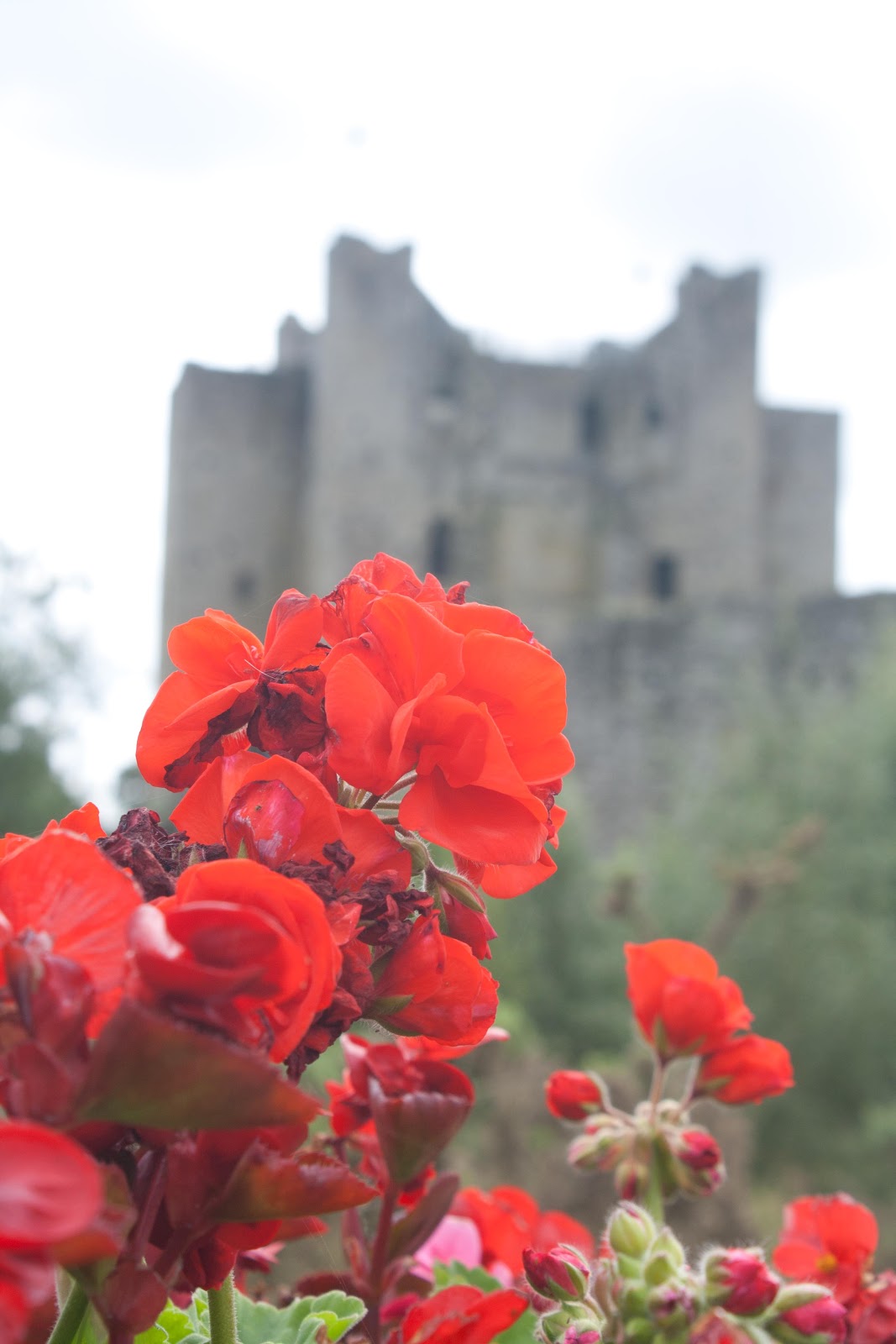
Now it's the flower's turn
Dave on the Hill of Tara

Where magic ensued, looking across to the rival hill

Dave hanging at the Hill of Tara with the mound of hostages behind him

A fairy tree at the hill of Tara, apparently you tie something to the tree and by the time it degrades your wish will come true.  Though some people had tied plastic to it.  Perhaps their wishes are more long-term

Sunday, 2 October 2011

British History Museum

Mosaic - under the Bank of England
We went along to the British Museum the other day, where we had our terrible run-in with the worst restaurant in London.  I think the British Museum is going to be a bit like the Louvre, in that it's not really something you can tackle in a single day.  We went straight passed the hordes surrounding the Rosetta stone and up to the medieval Europe section. 

The British Museum is a funny place, just like the Louvre is kind of a memorial to the pillaging of Napoleon, the British Museum is dedicated to the pillaging of the world.  If there's one thing the British did well (at least in quantity) it was colonisation.  And all these lovely artifacts from around the world thus ended up in the museum. 

There's a lot of annoyed countries demanding the return of historical artifacts.  The British Museum's argument is that they can better care for the objects than those countries.  It's a funny argument, can any country claim ownership of humanities shared history?  Just because something comes from a paticular country does that country necessarily have a bigger connection to the object than other people?  Can the British Museum really look after objects better than other countries, or is it more that if the artefacts are returned the British Museum is likely to find itself obsolete?  It has returned some things though, the remains of Tasmanian aborigines for one, after a 20 year battle, but I guess it's not completely inhumane.

Bronze horned helmet 150-50BC, found in the Thames
Recently there has been a radio programme here, a daily show running for 15 minutes which covers 100 objects in the Museum which have shaped human history.  These then become sort of the top-100 things to see in the museum, which is very smart as it gets people away from the Rosetta stone and the Elgin marbles and into the rest of the museum.  Though it's good to see that the curator of the museum chose as one of these top 100 the gold Mold cape.   This is a 4000 year old cape or solid gold which Wales is desperately trying to get returned.  That's never happening though.